
Your home is likely your single largest financial asset. Protecting it against catastrophic loss is not just smart; it is an absolute necessity. However, the insurance landscape in 2026 is incredibly volatile.
Severe environmental shifts have caused a massive spike in property damage. Unprecedented wildfires, relentless hurricanes, and flash floods have forced many major carriers to raise rates drastically. Some providers are abandoning entire states completely. This leaves thousands of homeowners scrambling to find affordable coverage.
Ignoring your current policy details can lead to a financial disaster. If a house fire destroys your home today, your outdated policy limits might only cover half the cost of rebuilding. Construction materials and labor costs have skyrocketed since 2020. You cannot rely on a policy written five years ago to protect you today.
You must take immediate action to secure your home. Do not wait for your current premium to double at renewal time. You can get matched with top-rated national insurance carriers right now to lock in the exact coverage you need at a price you can actually afford.
This comprehensive guide breaks down exactly how home insurance works in 2026. We will explain complex coverage limits, expose the hidden factors driving up your costs, and show you exactly how to structure your policy to avoid bankruptcy after a disaster.

1. The Four Pillars of Coverage
A standard homeowners insurance policy is actually a package deal. It groups several different types of protection into one contract. You need to understand these four core pillars to avoid leaving yourself vulnerable to massive out-of-pocket expenses.
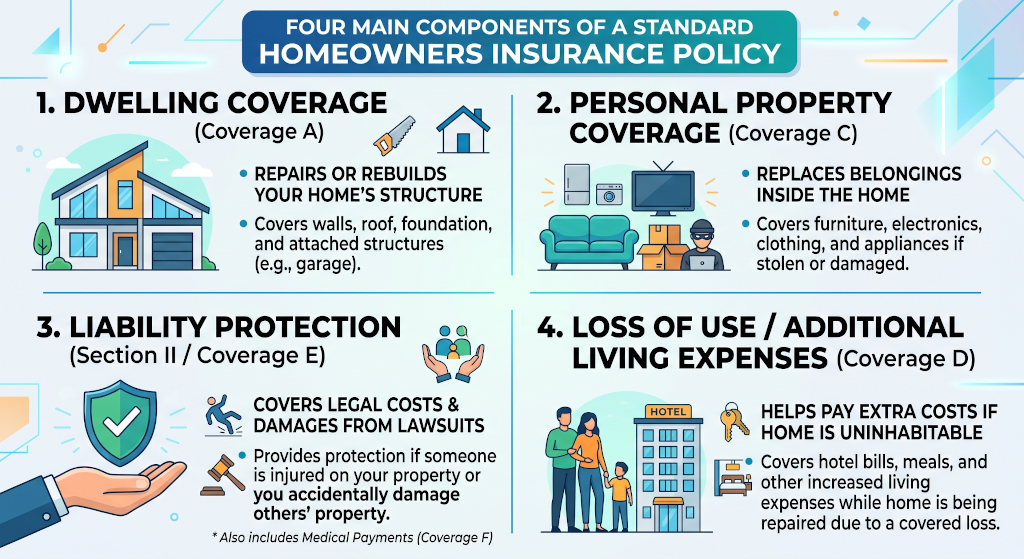
Dwelling Coverage (Coverage A)
This is the absolute foundation of your policy. Dwelling coverage pays to repair or completely rebuild the physical structure of your home if it is damaged by a covered peril. Covered perils typically include fire, windstorms, hail, and vandalism. This coverage also extends to attached structures like garages and wooden decks.
The biggest mistake homeowners make is setting this limit based on the real estate value of the home. Your real estate value includes the dirt your house sits on. Dwelling coverage should strictly reflect the local cost of materials and labor required to rebuild the house from the ground up.
Personal Property Coverage (Coverage C)
If you take the roof off your house and turn it upside down, everything that falls out is personal property. This coverage pays to replace your furniture, electronics, clothing, and appliances. Standard policies set this limit at roughly 50% to 70% of your total dwelling coverage.
You must know whether your policy offers Replacement Cost or Actual Cash Value (ACV) for your belongings. ACV pays you pennies on the dollar for older items due to depreciation. You should always demand Replacement Cost coverage to ensure you can buy brand-new replacements.
Liability Protection (Coverage E)
This protects your bank account from devastating lawsuits. If a delivery driver slips on your icy driveway and breaks his back, he will sue you. Liability coverage pays for his medical bills, your legal defense fees, and any court-ordered settlements. A standard policy offers $100,000 in coverage, but experts strongly recommend increasing this to at least $300,000.
Loss of Use (Coverage D)
If a severe fire leaves your home completely uninhabitable, you need a place to live during the six-month rebuild process. Loss of Use coverage pays for your temporary hotel bills, apartment rent, and even increased food costs while you are displaced from your primary residence.
2. What Drives Your Insurance Costs in 2026?
Insurance companies use complex algorithms to determine your exact premium. They are calculating the statistical probability that you will file a costly claim. Understanding these variables gives you the power to lower your rates.
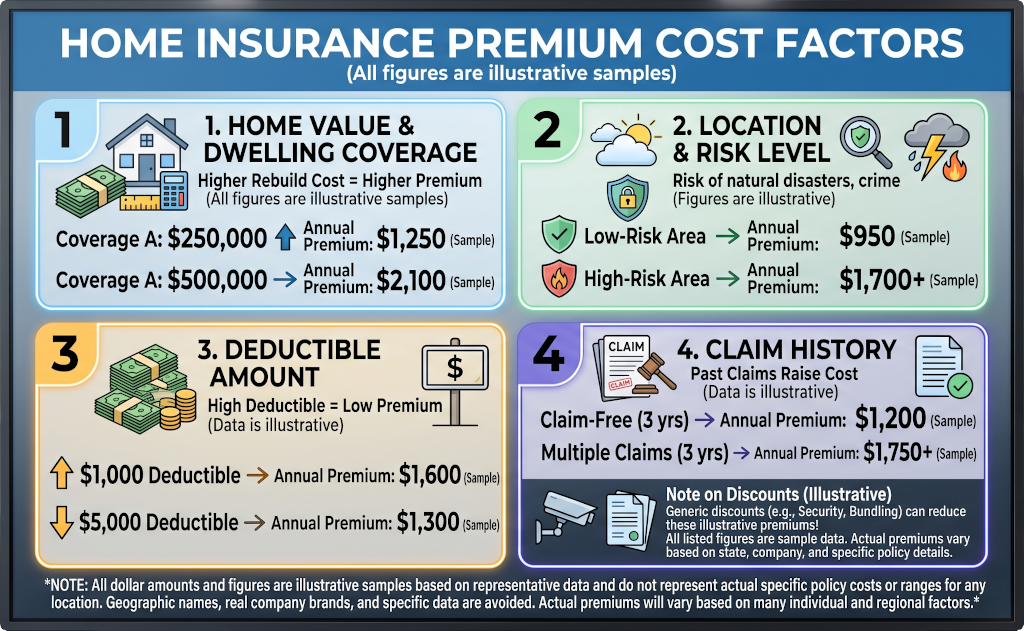
- Your Exact ZIP Code: Location is the largest pricing factor. Homes situated in dense wildfire zones, coastal hurricane paths, or high-crime urban areas face massive premium surcharges. Even proximity to a fire hydrant can change your rate.
- Your Personal Credit History: In almost every state, insurers legally use a specialized credit-based insurance score. Statistics show that homeowners with poor credit file claims more frequently. Improving your credit score directly lowers your annual premium.
- The Age of Your Roof: The roof is the first line of defense against severe weather. If your asphalt shingle roof is over 15 years old, carriers will drastically increase your rate or flat-out refuse to cover wind and hail damage.
- Your Claims History: Filing a small $1,000 claim for minor fence damage is a terrible idea. Carriers heavily penalize homeowners with a history of frequent claims. Save your insurance for catastrophic, life-altering losses.
- Attractive Nuisances: Features that increase the risk of severe injury drive up liability costs. Trampolines, aggressive dog breeds, and swimming pools without proper safety fences will instantly increase your monthly bill.

3. Choosing the Right Policy Form: HO-3 vs. HO-5
Not all insurance contracts are created equal. When reviewing a quote, you must look at the specific policy form being offered. The vast majority of American homeowners choose between an HO-3 and an HO-5 policy.
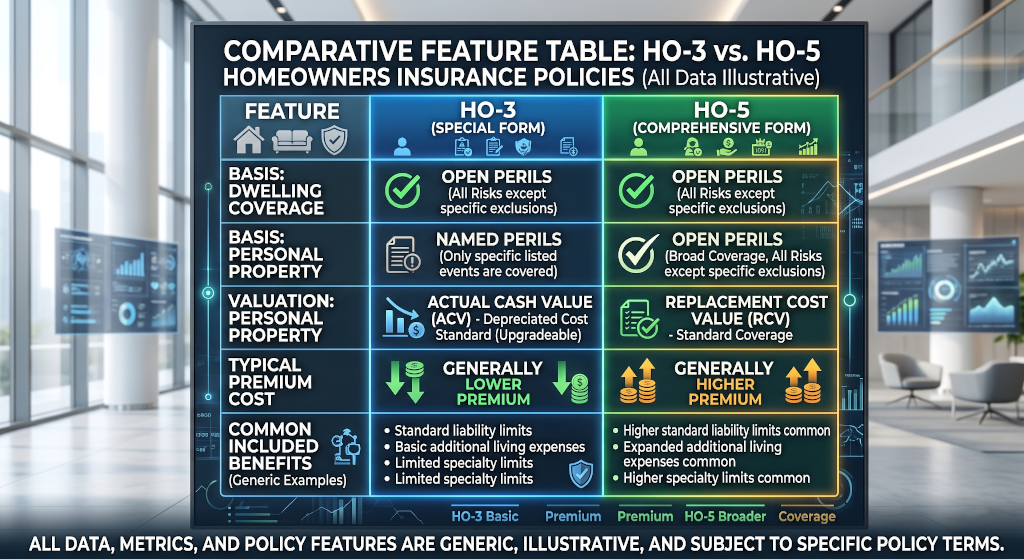
Here is a direct comparison of how these two distinct policies protect your hard-earned assets.
| Feature | HO-3 Policy (Standard Form) | HO-5 Policy (Comprehensive Form) |
|---|---|---|
| Dwelling Protection | Open Peril (Covers everything unless excluded) | Open Peril (Covers everything unless excluded) |
| Personal Property Protection | Named Peril (Only covers 16 specific disasters) | Open Peril (Covers everything unless excluded) |
| Burden of Proof for Claims | You must prove the specific disaster caused the damage. | The insurance company must prove an exclusion applies. |
| Valuation Method | Usually Actual Cash Value (ACV) for belongings. | Always Replacement Cost for belongings. |
| Overall Cost | More affordable and widely available. | More expensive, requires a well-maintained home. |
If you own high-value items, expensive electronics, or fine art, the HO-5 policy is vastly superior. It provides broader protection and removes the headache of fighting over depreciation during a stressful claims process.
4. Proactive Risk Mitigation: How to Force Your Rates Down
You do not have to accept aggressive rate hikes passively. By making your home demonstrably safer, you can force insurance companies to offer you deep discounts. You must prove to them that your house is a low-risk investment.
First, tackle water damage. Burst pipes are the most common source of expensive claims. Installing a smart water shut-off valve on your main plumbing line can stop a catastrophic flood before it starts. Carriers offer significant discounts for these connected devices.
Next, focus on security. A standard deadbolt is not enough. Installing a centrally monitored burglar and fire alarm system can reduce your premium by up to 10%. The system must automatically dispatch local police or fire departments to qualify for the maximum discount.
Finally, consider wind mitigation. If you live in a storm-prone state, upgrading your roof with hurricane straps, secondary water resistance, and impact-rated shingles can literally cut your windstorm premium in half. An official wind mitigation inspection is required to secure these savings.
5. Navigating the Claims Process Like a Pro
When a disaster strikes, your immediate actions dictate how quickly you receive a payout. The claims process is complex, and simple mistakes can lead to severe delays or outright denials. Follow these strict steps to protect your claim.
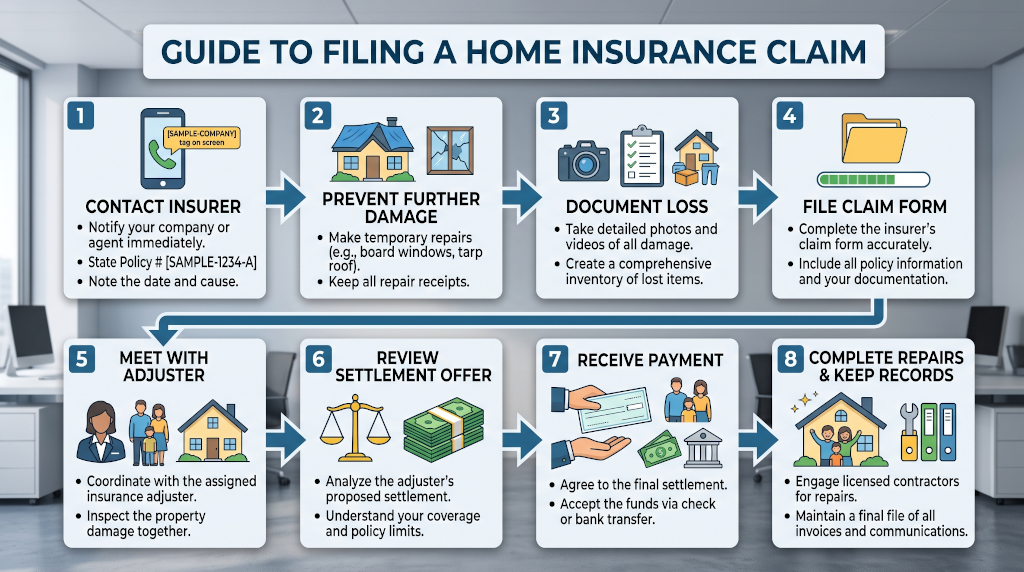
- Prevent Further Damage: Your policy strictly requires you to mitigate further loss. If a tree smashes your roof, you must immediately hire someone to lay a heavy tarp over the hole. If a pipe bursts, shut off the water main instantly. Do not wait for the adjuster to arrive.
- Document Everything Obsessively: Before cleaning up a single piece of debris, take hundreds of clear photos and detailed videos of the damage. Capture the destroyed items, the structural damage, and the surrounding area. This is your undeniable proof.
- File the Claim Promptly: Call your carrier immediately. Delays can give the company a reason to deny your claim. Keep a dedicated log of every single phone call, including the date, time, and the name of the representative you spoke with.
- Do Not Throw Anything Away: Even if a ruined sofa smells terrible after a flood, drag it to the backyard and leave it there. The claims adjuster must physically see the ruined items to approve the payout. Discarded items cannot be claimed.
- Review the Initial Estimate Carefully: The first check the insurance company offers is rarely their best offer. Do not sign a final release form immediately. Have a trusted local contractor review the adjuster's estimate to ensure they included the true cost of local labor and materials.

6. Frequently Asked Questions (FAQ)
How much does homeowners insurance cost in 2026?
In 2026, the national average cost for homeowners insurance is between $1,800 and $2,500 annually. However, prices vary wildly based on your location. Homes in coastal areas or wildfire zones can easily see premiums exceeding $4,000 per year.
What is the difference between replacement cost and actual cash value?
Replacement cost covers the exact price to rebuild your home or buy new items at today's market rates without deducting for depreciation. Actual cash value (ACV) only pays what your items were worth at the time of the loss, meaning you will receive significantly less money for older roofs and aging electronics.
Does standard home insurance cover floods and earthquakes?
No. Standard homeowners insurance strictly excludes damage from natural floods and earthquakes. If you live in a flood zone or an area prone to seismic activity, you must purchase a completely separate flood or earthquake insurance policy through specialized programs.
How can I lower my annual home insurance premium?
You can lower your premium by bundling your home and auto policies with the same carrier. Raising your deductible from $1,000 to $2,500 can also reduce your yearly rate. Finally, installing central burglar alarms, water leak detectors, and upgrading your roof will qualify you for significant safety discounts.