
Electricity rates are climbing at an alarming pace across the United States. In 2026, homeowners are routinely seeing their monthly utility bills spike by 15% to 20% year over year. Aging power grids and extreme weather events are making reliable electricity more expensive than ever before.
Renting your power from a local utility company leaves you completely vulnerable to endless rate hikes. Every time the grid fails or the cost of natural gas jumps, you pay the price. Transitioning to a residential solar panel system gives you immediate control over your monthly expenses and protects your family against sudden inflation.
Adding a solar array to your roof is a massive home improvement project. It is easy to get overwhelmed by complex technical jargon, aggressive sales tactics, and confusing financial calculations. This guide strips away the marketing noise to give you the exact facts you need to make a smart, profitable decision for your home.
If you are tired of opening massive utility bills every month, the time to act is right now. You can get matched with vetted, local solar experts instantly to secure competitive installation bids and lock in current federal tax incentives before regulations change.

1. How Residential Solar Power Actually Works
A solar energy system consists of a few critical components that work seamlessly together. Understanding these basic parts will prevent you from being oversold by a fast-talking contractor.
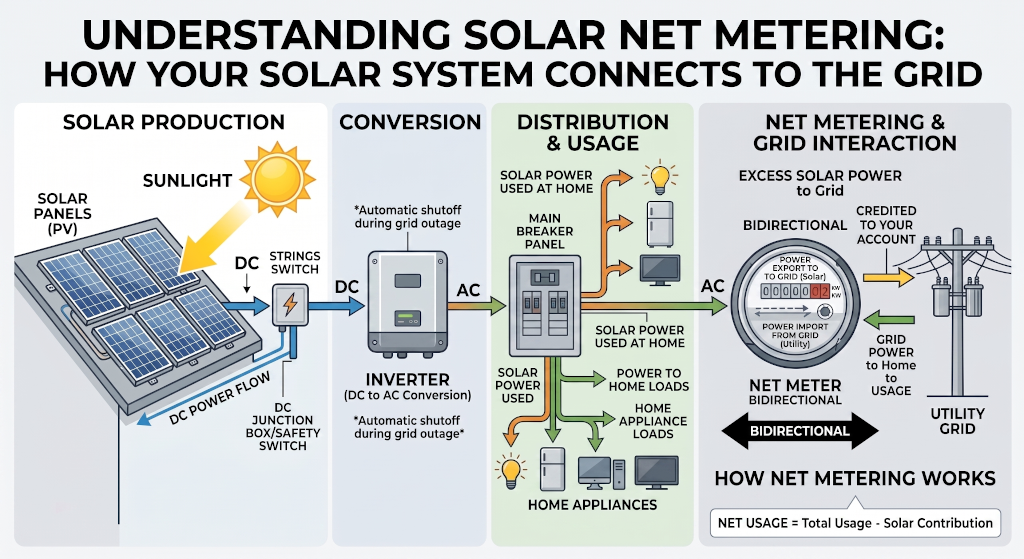
The Core Components
The dark glass panels on your roof are made of silicon photovoltaic (PV) cells. When sunlight hits these cells, they instantly generate direct current (DC) electricity. However, the appliances inside your house require alternating current (AC) electricity to function.
This is where the inverter comes in. The inverter acts as the brain of your system, constantly converting raw DC power into usable AC power. Traditional systems use one large string inverter mounted on the side of your house. Modern premium systems use microinverters, attaching a tiny individual inverter directly beneath every single panel for maximum efficiency.
Understanding Net Metering
Your solar panels will produce maximum power during the middle of the day when the sun is brightest. Ironically, this is usually when your family is away at work or school, meaning your house is using very little electricity. Net metering is the financial mechanism that solves this problem.
Under a net metering agreement, your home automatically sends all excess solar power directly back into the public utility grid. Your electric company tracks this contribution and credits your account. At night, when your panels stop producing, you pull electricity back from the grid, using the credits you banked during the day.
Your goal is to size your system to completely offset your annual usage. If your system is designed correctly, you will essentially eliminate your electricity bill, leaving only a small mandatory connection fee from the utility company.
2. The True Cost of Solar Panels in 2026
Pricing for solar installations is measured in cost-per-watt. The total price you pay depends heavily on the physical size of your home, your historical energy consumption, and the quality of the equipment you select. The national average cost for a professional residential solar installation in 2026 hovers around $3.15 per watt before tax credits.
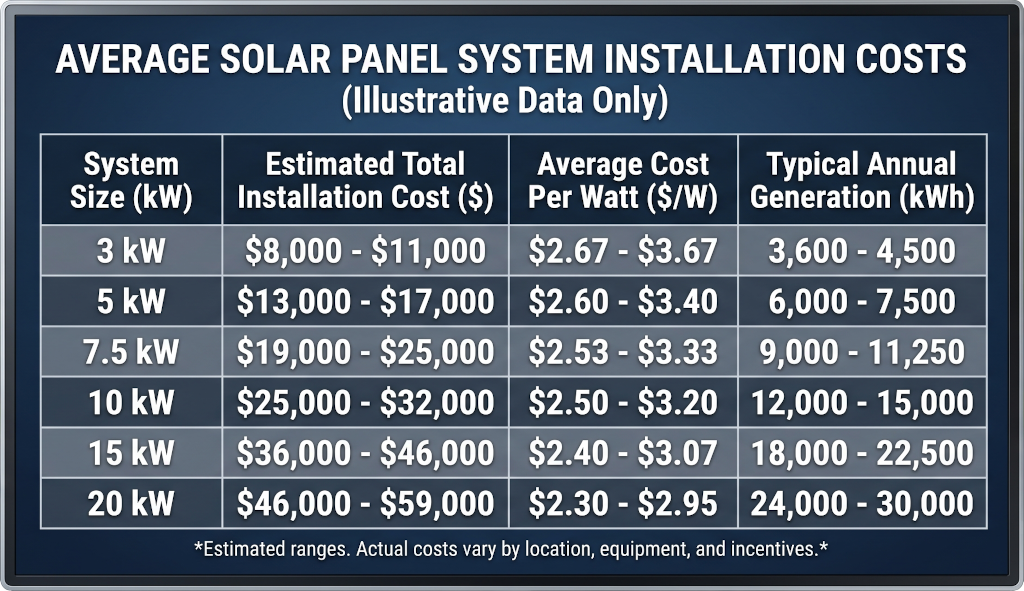
To help you set a realistic budget, review the national average cost breakdown based on common system sizes. These estimates reflect the total installation price including parts, labor, and necessary permitting.
| System Size (Kilowatts) | Estimated Home Size (Sq Ft) | Average Gross Cost (Before Credits) | Net Cost (After 30% Federal ITC) |
|---|---|---|---|
| 4 kW | 1,000 - 1,500 | $12,600 | $8,820 |
| 6 kW | 1,500 - 2,000 | $18,900 | $13,230 |
| 8 kW | 2,000 - 2,500 | $25,200 | $17,640 |
| 10 kW | 2,500 - 3,000 | $31,500 | $22,050 |
| 12 kW | 3,000+ | $37,800 | $26,460 |
*Note: Actual pricing varies by region. Upgrading an old electrical panel, removing large shading trees, or adding heavy duty racking for a steep roof will add slightly to your final installation cost.
Equipment Quality Impacts Price
Not all solar panels are created equal. Budget-tier panels cost less upfront but degrade faster over their 25-year lifespan. Tier-one panels (like Maxeon, Panasonic, or Qcells) carry a premium price tag but guarantee higher efficiency. If you have limited roof space, you must buy expensive, high-efficiency panels to generate enough power.

3. Understanding the 30% Federal Solar Tax Credit
The single greatest financial incentive for adopting solar power is the federal Investment Tax Credit (ITC). Through 2032, this legislation allows you to deduct exactly 30% of your total solar installation cost directly from your federal tax liability.
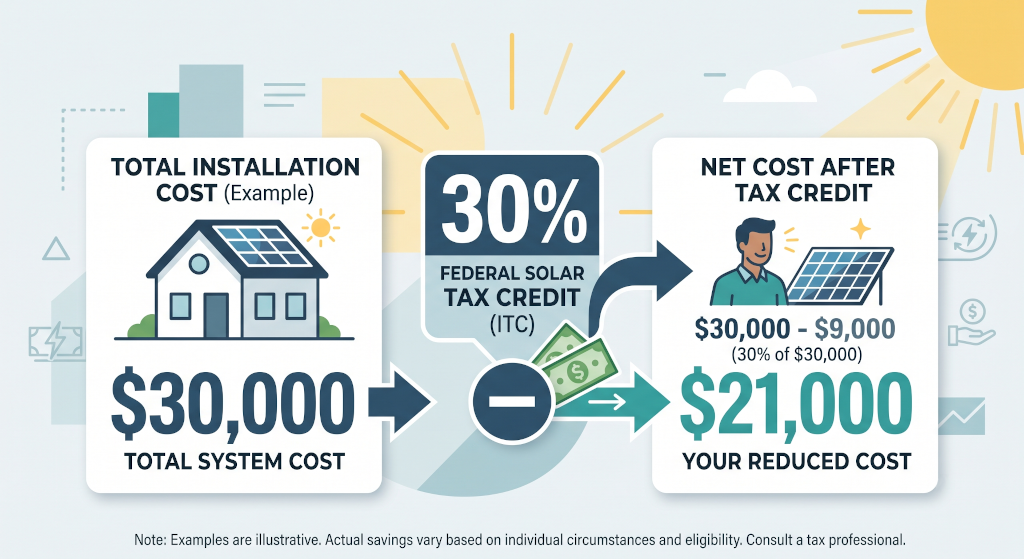
How the Tax Credit Actually Works
The ITC is a dollar-for-dollar reduction in the income taxes that you owe the federal government. If you purchase a $25,000 solar system, your 30% credit equals $7,500. When you file your taxes the following spring, you simply owe the IRS $7,500 less than you normally would.
If you have a regular W-2 job where taxes are withheld from every paycheck, claiming the credit will likely result in a massive tax refund check. The credit applies to the entire project cost, including the solar panels, the inverters, all electrical labor, and any required roof mounting hardware.
Rollover Rules and Tax Liability
The ITC is non-refundable. This means the government will not send you a check for money you did not owe in the first place. You must have sufficient taxable income to claim the credit. However, if your $7,500 credit is larger than your total tax bill for the year, you do not lose the money. The remaining balance automatically rolls over to the next tax year.
4. Financing Your System: Cash vs. Loans vs. Leases
How you pay for your solar system drastically changes your long-term return on investment (ROI). Because solar is a long-term asset, choosing the wrong financing structure can trap you in a bad contract that complicates selling your home later.
The Cash Purchase
Paying cash upfront is always the most profitable way to go solar. You avoid all dealer fees, massive loan origination fees, and compound interest. A cash purchase delivers the absolute fastest break-even point. Most homeowners who pay cash recover their entire initial investment through utility savings in just six to eight years.
Solar Loans
Most Americans do not have $25,000 sitting in a checking account. Solar loans allow you to own the system immediately while paying it off over 10 to 20 years. Because you are the legal owner, you still claim the 30% federal tax credit yourself.
Your goal with a solar loan is to swap your variable electric bill for a fixed loan payment. If your current electric bill is $200 a month, and your new solar loan payment is $160 a month, you start saving money on day one. Always read the fine print; solar financing companies often charge massive upfront "dealer fees" to buy down the interest rate artificially.
Solar Leases and Power Purchase Agreements (PPAs)
If you sign a solar lease or a PPA, you do not own the panels on your roof. A massive third-party solar corporation owns the equipment. They install it on your house for zero dollars down, and you agree to buy the generated power back from them at a locked-in rate for 25 years.
Because you do not own the system, the solar corporation claims your 30% federal tax credit. Leases generally offer the lowest long-term financial return. They can also create major legal hurdles if you try to sell your home, as the new buyer must agree to take over the remaining years of the lease contract.

5. Solar Batteries: Do You Need Backup Storage?
A common misconception is that solar panels will keep your lights on during a hurricane or winter storm. This is totally false. Standard grid-tied solar systems intentionally shut down during blackouts to prevent back-feeding electricity and electrocuting line workers repairing the grid.
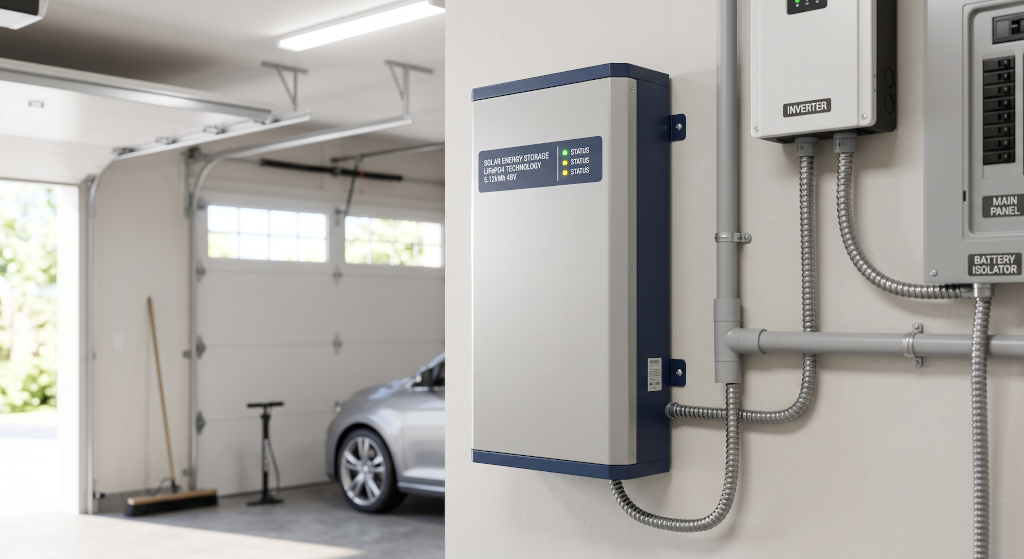
To have true energy independence during a grid failure, you must install a solar battery backup system. Modern solar batteries use advanced lithium iron phosphate (LiFePO4) chemistry. They are incredibly safe, mount cleanly to your garage wall, and provide seamless backup power.
When the grid goes down, your house automatically disconnects from the street. Your solar panels route power directly to the battery, and the battery powers your critical loads (refrigerators, well pumps, internet routers). If you live in an area prone to severe weather or rolling blackouts, adding a battery is worth the extra $10,000 investment. The 30% federal tax credit fully applies to battery installations.
6. How to Vet and Hire a Local Solar Installer
The solar industry has exploded, bringing thousands of new contractors into the market. Unfortunately, this rapid growth has attracted predatory door-to-door salesmen and fly-by-night installation crews. To protect your roof and your wallet, you must thoroughly vet any company before signing a contract.
Follow these strict guidelines when hiring a solar professional:
- Demand NABCEP Certification: The North American Board of Certified Energy Practitioners (NABCEP) is the gold standard for solar installers. Never hire a company that does not employ actively certified NABCEP design engineers and lead installers.
- Verify Roof Penetration Warranties: Drilling dozens of lag bolts into your roof is risky. A reputable installer will provide a 10-year watertight warranty guaranteeing their mounting hardware will not cause roof leaks. Do not accept verbal promises; demand this in the written contract.
- Avoid High-Pressure Door Knockers: If a salesperson knocks on your door and demands you sign an agreement "today to secure a special rebate," close the door immediately. Legitimate solar quotes require careful historical energy analysis and custom engineering. Never sign anything under pressure.
- Check Subcontracting Practices: Ask the sales rep directly if their company performs the physical installation using W-2 employees, or if they simply sell the contract and hire cheap local subcontractors. Direct-labor companies offer vastly superior quality control.
7. Frequently Asked Questions (FAQ)
How much do solar panels cost for a 2,000 sq ft home in 2026?
In 2026, a solar panel system for a typical 2,000-square-foot home costs between $16,000 and $25,000 before applying any tax credits. After applying the 30% federal tax credit, the net cost drops to between $11,200 and $17,500. Exact pricing depends heavily on your local labor rates, the type of panels used, and your average monthly electricity consumption.
Does the 30% federal solar tax credit still exist?
Yes, the 30% federal solar Investment Tax Credit (ITC) is fully active and guaranteed through 2032 under current legislation. This credit allows you to deduct 30% of the total installation cost of your solar system directly from your federal taxes. It also applies to solar battery storage systems installed alongside the panels.
How long do modern solar panels actually last?
Modern monocrystalline solar panels are engineered to last 25 to 30 years. Most tier-one manufacturers provide a 25-year linear performance warranty guaranteeing the panels will still produce at least 80% to 85% of their original power output at the end of that timeframe. Inverters typically need replacement after 12 to 15 years.
Will my solar panels keep the power on during a grid outage?
Standard grid-tied solar panels will automatically shut down during a power outage for safety reasons, preventing electricity from back-feeding into power lines and injuring repair workers. To keep your power on during an outage, you must install a solar battery backup system alongside your panels.